
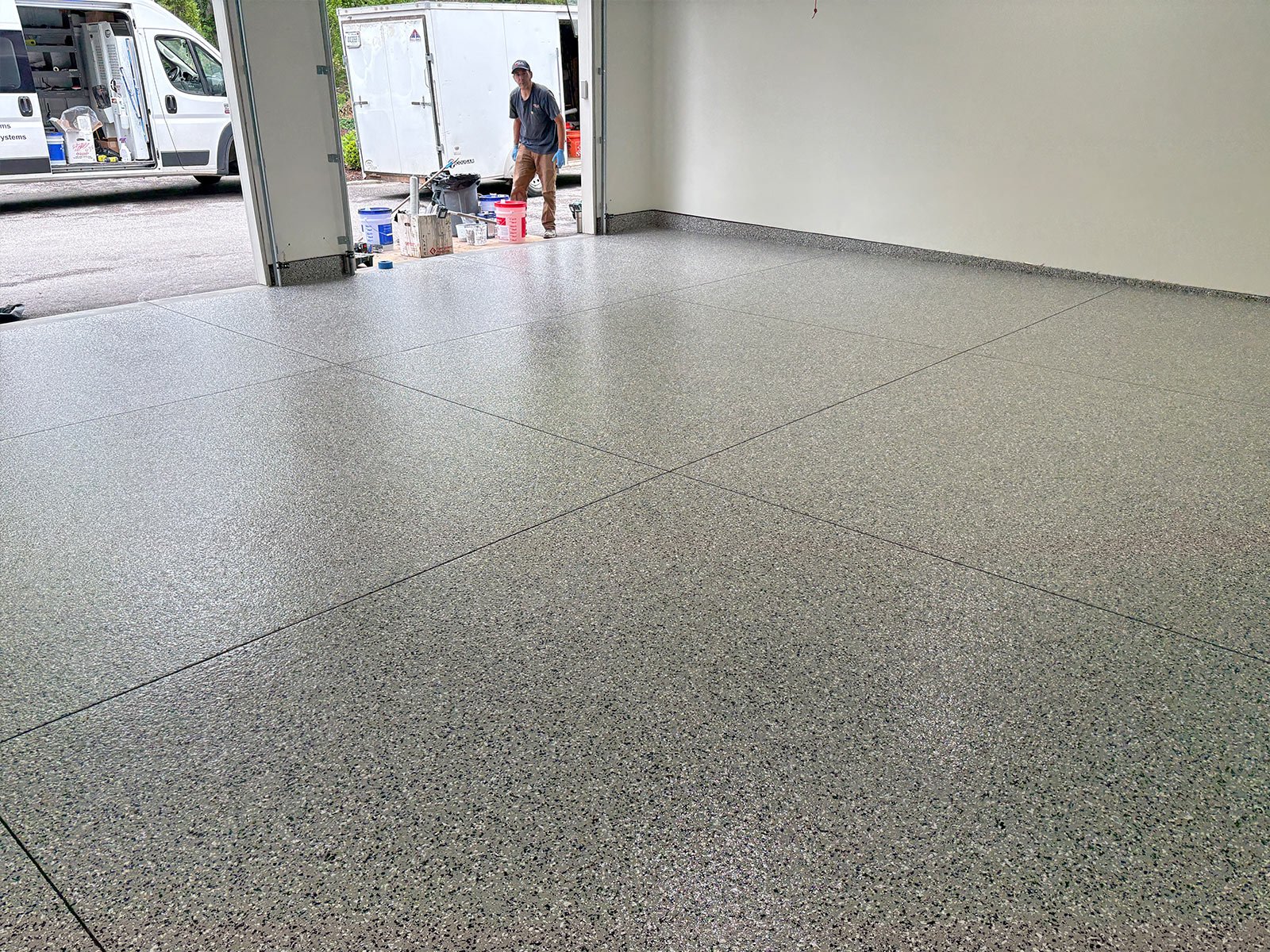
The main types of garage flooring are coatings, which bond to the concrete, and coverings, which lie on top of it. Coatings are sealer, floor paint, epoxy and polyaspartic. Coverings are interlocking tiles, roll-out mats, peel-and-stick tile, porcelain and luxury vinyl.
Your slab decides which ones will work, so check the slab first, then pick. The one we install is covered in epoxy garage floor installation.
What are the two kinds of garage flooring?

Every garage floor is one of two kinds. The kind decides how it handles cracks, spills and moisture.
Coatings: a layer bonded to the slab
A liquid that cures into the top of the concrete.
What countsSealer, floor paint, epoxy and polyaspartic.
StrengthIt bonds to the slab, so there are no seams.
Watch forMoisture rising from below can push it up in a blister.
Coverings: a product laid on top of the slab
A finished product laid on top of the concrete.
What countsInterlocking tiles, roll-out mats, peel-and-stick tile, porcelain and luxury vinyl.
StrengthMats and tiles need almost no prep and cover cracks and stains.
Watch forSpills find the seams, and water can collect underneath.
Moisture is where the two kinds split. Water moving up through a slab pushes a bonded coating off from below. Under a covering, the same water has nowhere to go.
The Spruce says tiles and mats are more likely than coatings to hold moisture underneath. Either way, a damp slab gets tested and dealt with before any floor goes down.
Types of garage flooring compared: cost and what each needs

Open any floor to see what it asks of your slab and where it falls short. Costs are per square foot.
Coatings: they bond to the slab
Sealed concrete$0.20 to $0.60 materials, $2 to $3 labor
What it asks of the slabA clean, dry slab.
Where it falls shortNeeds reapplying about every year. It darkens the concrete a little and adds some gloss, but no color.
Floor paint$2.50 to $5 materials and labor
What it asks of the slabA clean slab, patched cracks and a primer.
Where it falls shortChips and peels under impact and moisture. Plan to repeat it about every 3 years.
“Epoxy paint” kit$3 to $13 materials and labor
What it asks of the slabThe same prep as paint, done by you.
Where it falls shortSome are latex paint with a little epoxy added, not true epoxy.
Epoxy base with polyaspartic topcoatPriced for your garage at an on-site estimate
What it asks of the slabA slab that is ground, repaired and dry. We do the grinding and repairs.
Where it falls shortCosts more than paint, mats or tiles. A damp slab has to be dealt with first.
Coverings: they rest on the slab
Roll-out mats$1.50 to $4 materials, about $2 labor
What it asks of the slabAlmost nothing. Fill large holes and cracks that could spread.
Where it falls shortFluid can get under the seams.
Interlocking tiles$2.29 to $7.50 materials
What it asks of the slabAlmost nothing. They cover cracks and stains.
Where it falls shortSand and litter work into the gaps. Water can collect underneath.
Peel-and-stick tile$1 to $5 materials and labor
What it asks of the slabA perfectly flat, clean, dry slab.
Where it falls shortFails over cracks, ridges or any sign of moisture.
Porcelain or luxury vinylPorcelain: $1 to $30 materials, $9 to $50 installation. Vinyl: $3 to $13 installed
What it asks of the slabPorcelain needs a flat, dry slab. Vinyl hides a few cracks.
Where it falls shortHighest cost range. Vinyl plank suits an insulated garage more than a cold one.
Costs are national figures from Family Handyman, updated May 2025. They are wide, and St. Louis prices will differ. The weak spots come from Family Handyman, The Spruce, Bob Vila and Car and Driver, named in the sections below.
Read the label on any epoxy kit. The Spruce separates real epoxy from epoxy paint, and the two are not the same product. A paint kit also leaves the grinding and crack repair to you.
Check your slab before you pick a floor

These three checks need no tools. They are quick screens, not lab tests, and each one tells you which floors to cross off. Open the one you want to try.
1. The plastic sheet: is the slab damp?
What to do. Tape a square of clear plastic tight to a bare, clean spot, sealing all four edges. Leave it for a day.
What you see. Water drops or a cloudy film on the underside mean the slab is giving off moisture. A clear, dry sheet only tells you none showed on that day.
Rules out if damp: peel-and-stick tile, porcelain and floor paint. A coating needs a proper moisture test and a barrier first. Our epoxy floor preparation guide covers the three tests installers use.
2. The water drop: is something sealed on?
What to do. Pour a little water on a bare, clean spot.
What you see. Water that soaks in means the surface is open. Water that beads up means something is on it, such as old paint, sealer or oil.
Rules out if it beads: new paint or a coating over the top. The old layer has to come off first. Tiles and mats do not care, because they do not bond.
3. The crack walk: is the slab moving?
What to do. Walk the whole floor and look for cracks, and for any spot that sits higher than the next.
What you see. Hairline cracks are normal in garage slabs. A crack that is wide, has grown, or has one side higher than the other means the slab is moving.
Rules out if it is moving: peel-and-stick tile and porcelain, which need a flat slab. A coating only goes down after the crack is repaired, and a moving crack needs a look in person first. See five signs a garage floor needs replacing.
 A cracked slab during grinding. Cracks like these are repaired before a coating goes down.
Which floor fits your slab?
Which floors fit your garage?
Tap what your slab is like and what matters most. Your shortlist appears right below. If you are not sure about your slab, do the three checks above first.
What is your slab like?
What matters most to you?
Pick your slab first, then what matters most.
Or read every answer in one table
| Your slab | A floor that lasts | The lowest cost | What it rules out |
|---|---|---|---|
| Sound and dry | A professional epoxy and polyaspartic coating. It bonds to the slab. | Floor paint or roll-out mats. Paint costs least, but plan to repeat it about every 3 years. Mats are not fixed down, so they lift out. | Nothing. Every type listed above can go on a sound, dry slab. |
| Cracked or uneven | A coating, after the cracks are repaired. A crack that keeps moving needs a look in person first. | Interlocking tiles or roll-out mats. They cover cracks and some unevenness. | Peel-and-stick tile and porcelain. Both need a perfectly flat slab. |
| Damp, or white powder on the surface | Test first. A coating needs a moisture barrier under it, and some damp slabs need the water problem fixed before any floor. | Roll-out mats or interlocking tiles can sit over it, but water collects underneath. Lift a corner now and then and look. | Peel-and-stick tile, porcelain and floor paint. Moisture is what they cannot take. |
| Oil stains or old paint | A coating, after grinding takes the oil and old paint off. | Mats or interlocking tiles. They cover stains and need no prep. | New paint over the old surface, and peel-and-stick tile. Both need a clean slab. |
The table is a starting point. A slab can show two problems at once, and then the strictest answer wins.
Do tiles and mats leak? What a two-week test found

Are garage floor tiles worth it?
Read the full answer

Are garage floor mats a good idea?
Read the full answer
Car and Driver tested garage mats and tiles for two weeks, with car fluids poured on each one. Three results matter when you choose a covering.
- Fluid got under a matOn a vinyl mat, fluid ran through the seams and left discoloration on the concrete below.
- Litter got between tilesSand and kitty litter worked into the joints between interlocking tiles.
- Trapped liquid stainedWhere liquid was trapped and could not evaporate, one product discolored slightly.
The weak spot of a covering is its seams. A bonded coating has no seams to leak through.
A covering is a fair choice for a short stay. Expect to lift it and clean underneath now and then.
How a St. Louis winter treats your slab
In a St. Louis winter, cars bring slush and road salt into the garage, and the slab goes through freezing and thawing. The National Ready Mixed Concrete Association, in its Concrete in Practice sheet CIP 2, Scaling Concrete Surfaces, gives three rules that apply to a garage slab.
- Rinse the salt offHose off the salt that cars drop on a garage slab when you can. Use deicers in moderate amounts, because too much raises the risk of scaling.
- No fertilizer deicersNever use deicers made of ammonium sulfate or ammonium nitrate. They attack concrete.
- Let water drainPoor drainage makes the damage worse. A garage where water sits is the one to test first.
Slush and salt are one more reason to look hard at a damp slab. Where snow and ice ride in on the vehicle, The Spruce suggests paint or a coating. Tiles and mats hold moisture under them.
What a repaired and coated slab looks like


The job above is one of our Clayton jobs, finished in July 2024. The 200 square foot floor was falling apart and the home was about to be listed. We repaired the concrete and coated it in a single day.
The coating was a HyperBond epoxy base coat with full flake, then an Aspartic 85 polyaspartic topcoat. For flake colors, metallic and solid color, see types of epoxy finishes. For how epoxy and polyaspartic compare, read polyaspartic vs epoxy.
More jobs, with before and after photos, are in our case studies.
We do not install tiles, mats, vinyl, paint or sealer, so their weak spots here come from other sources.
I am also called in to look at floors that another company installed and that have failed. An epoxy and polyaspartic coating is not for a garage that needs a quick, cheap, removable cover, and it is not for a slab that stays wet. The next section says what to pick instead.
When we would tell you to pick something else
- You are moving within a few yearsInterlocking tiles or roll-out mats go with you. A coating stays with the house.
- The slab is damp and nobody knows whyFind the water first. A coating needs a moisture barrier, and a slab that is wetter than the system allows should not be coated.
- The slab is cracked and still movingA coating will not stop a moving crack. We need to see it in person before anyone plans a floor.
- You want the lowest cost and will redo itFloor paint is the cheapest film coating. Accept the repeat every few years.
The longer list is in when not to use epoxy flooring in St. Louis.
Common questions about garage flooring
Short video answers

What is the best flooring for a garage?
Read the full answer

Can you install flooring over cracked concrete?
Read the full answer
Short clips from us. Each plays in a window on this page, so you keep your place.
What to do next
Not sure which floor fits your slab? Call 314-308-7780 or schedule an on-site estimate. We look at the slab and tell you which floor fits it.
See epoxy garage floor installation for the system and packages. Fenton, 772 Merus Ct., Monday through Friday, 8 AM to 5 PM. Garage Designs has been remodeling St. Louis garages since 2002.
