

A polyaspartic garage floor coating is the topcoat on top of an epoxy floor. It is not a separate floor you buy instead of epoxy. It is what makes the color hold up in sunlight, and what lets the whole job finish in about two days. It is on every floor we install. It is not an upgrade you have to ask for.
The short version
It is Aspartic 85, applied over a Floorguard HyperBond epoxy base, on every package we sell. That runs $6 to $10 per square foot installed. Walk on it after 24 hours. Give it 48 to 72 hours before a car goes back in.
There is a real chemical smell while it goes down and cures. It clears within about a day, before the floor is ready to use.
What the topcoat actually does
The base coat bonds to the concrete and holds the color flake. On its own it would work, but it would yellow in sunlight and scratch more easily under a hot tire. The polyaspartic topcoat goes on top and does three things the base coat cannot do alone. It blocks UV so the color does not fade. It resists gas, oil and cleaning chemicals. And it is what gives the floor its glossy, sealed look.
It also cures fast, which is the real reason it exists instead of a second coat of epoxy. Epoxy can take a full day just to cure enough to walk on. A polyaspartic coat is ready for foot traffic in a few hours. That speed is what lets a two-coat floor finish in two days instead of four.
What a polyaspartic garage floor coating costs
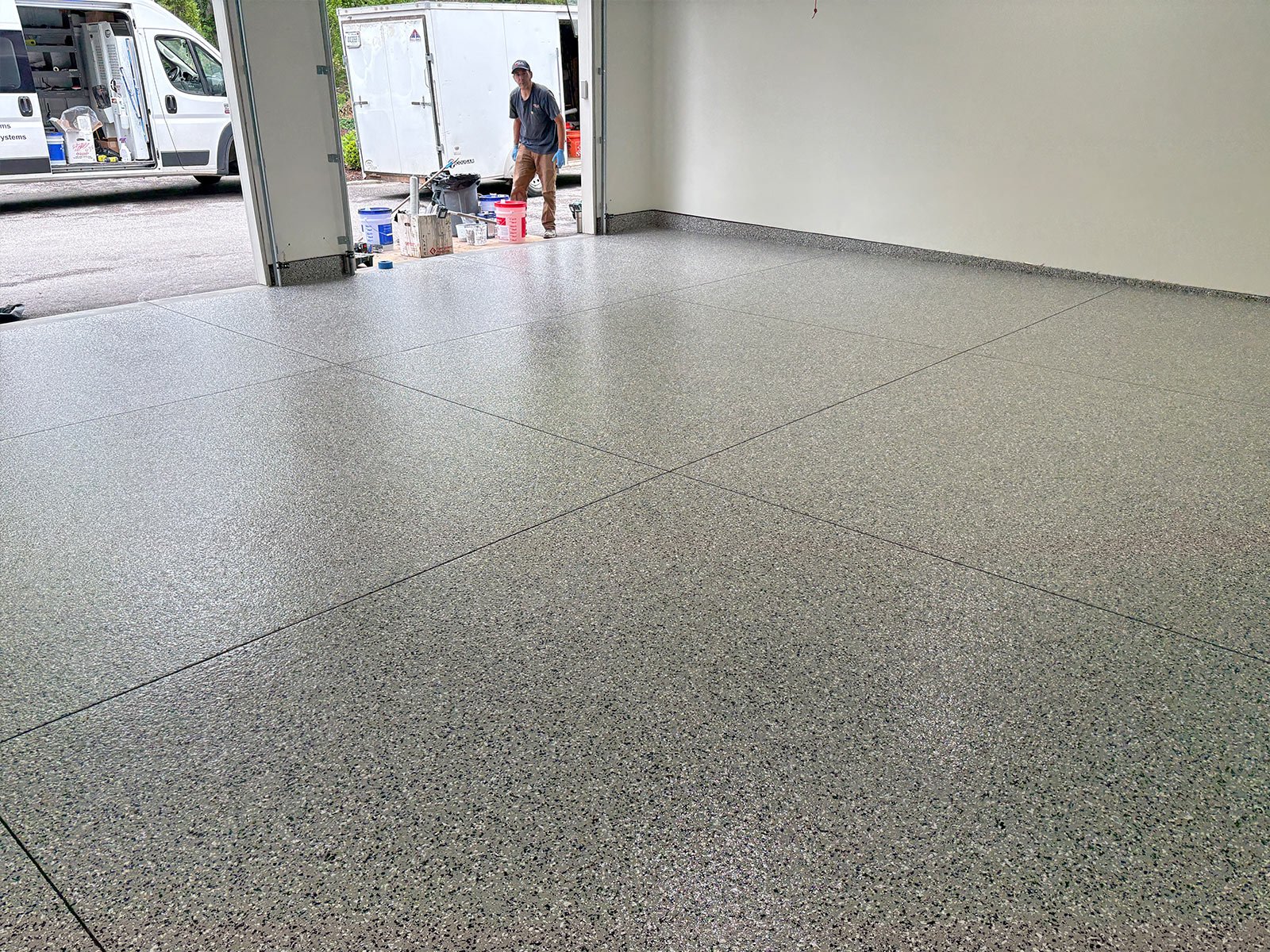
All three of our packages carry the same Floorguard HyperBond base and Aspartic 85 topcoat. The difference is prep and coat count, not whether the topcoat is included:
- Good ($6/sq ft). Diamond grinding, crack repair, the base coat, full flake, one coat of topcoat. Two days. Most homeowners with newer concrete choose this.
- Better ($8/sq ft). The same, plus a moisture barrier before the base coat goes down. Worth it on an older slab.
- Best ($10/sq ft). The moisture barrier, plus a second coat of topcoat. Extra film thickness that pays off in a higher-traffic garage.
All three carry the same limited lifetime warranty on workmanship. Full detail on what’s included in each package.
The real timeline: dry is not the same as cured
The floor can feel completely dry to the touch within a few hours, and it is still nowhere near ready for a tire. Touch-dry and hard-cured run on two different clocks. What you feel on the surface is solvent finishing its evaporation. What actually protects the floor is the resin and hardener underneath still linking together into a solid network, and that keeps going well after the surface stops feeling wet.
| Timeframe | What’s safe |
|---|---|
| 24 hours | Walking on it in socks or bare feet |
| 48 to 72 hours | A car, back in the garage |
| A full week | Fully cured, per the schedule we’ve used on every job since 2014 |
Cold slows the whole reaction, which pushes a winter job toward the slow side of those numbers rather than the fast side. What counts is how cold the slab itself is, not the air above it, and concrete can trail the outdoor temperature by a day or more after a hard freeze. Moving air across it speeds things back up; blasting it with a space heater does not, since that cooks the surface while the material below stays soft.
What happens if you rush the cure
Damage at this stage almost always comes down to one of three moments, not a bad coating:
- The car goes in early because the floor “felt” ready. A warm tire sitting in one spot on a coating that has not finished hardening leaves a permanent dent in the surface. There is no buffing it out.
- Something gets dragged instead of carried. A toolbox or a bin pulled across a floor that has not fully set drags the surface with it rather than sliding over it.
- Nobody was watching the floor. Dust, leaves, whatever blows in while the coating is still open gets locked into the finish instead of swept off it later.
All three are avoidable, and none of them are a sign the coating itself failed. They are timing mistakes, and the timeline above is what prevents them.
The smell, honestly

It is a real chemical smell, strongest on the day we are actually applying the coating. It is the same smell you’d notice standing in the Oakville garage pictured above while that topcoat went down. If the garage shares a wall or a door with the house, some of it will drift in. Cracking a window and running a fan clears it faster. By the time the floor is walkable, most people cannot smell anything left at all. It does not come back once the floor has cured.
Some sites raise this to sell interlocking tiles instead of a coated floor. It is a real tradeoff worth knowing, not a reason to skip the topcoat protecting the floor you are paying for. One day of a strong smell against fifteen-plus years of a floor that does not yellow is the actual comparison.
Kids, pets and a garage full of stuff
Keep kids and pets out of the garage entirely on install day and overnight. Wet coating on a paw or a shoe tracks through the house, and the fumes are strongest exactly then. Once the floor is walkable, a curious kid or dog wandering through is not a problem; the surface has set.
Whatever normally lives in the garage has to come out before the crew starts and stay out until the floor is walkable. A one-car garage with a full workbench and shelving against every wall takes longer to clear and refill than an empty two-car bay. That is worth planning around if this lands the same week as anything else.
A real floor: Oakville, two days
The Masksumic family’s garage in Oakville ran this exact system: diamond grinding and crack repair, the base coat and flake on day one, the topcoat on day two. Two days on site, and a finished floor before anyone needed to park in that garage again.
Still weighing epoxy against polyaspartic as if they were two separate floors? They are not, on any job we run. See our full breakdown of both materials for the technical comparison; this page covers what happens once the crew is on site.
If the slab itself is new
If your garage was poured in the last month, skip everything above for now. A slab needs about four weeks on its own before it can take any coating at all. Sealing it in sooner locks moisture underneath the surface, and that is one of the most common ways a floor gives out down the road, not on day one. New concrete also has a thin, weak skin on top called laitance. Grinding it away is what lets the coating grab onto real concrete instead of a layer that was never going to hold.
Common questions
Where to start
I am Brandon Coleman. I have run this exact system, and this exact schedule, on garages across the metro since 2014. Garage Designs has been remodeling St. Louis garages since 2002, out of a shop at 772 Merus Ct. in Fenton, MO 63026. It has held BBB accreditation since 2008.
Call 314-308-7780 or ask for a free in-home estimate. We measure the slab, tell you which package fits it, and give you the price and the schedule before anything starts. The office is open weekdays, 8 AM to 5 PM.
